
Search for fitness calculators and you will find dozens: BMI, BMR, TDEE, body fat, one-rep max, macros, calories burned, ideal weight, body age, and more. Most people open three or four of them, get numbers that don’t quite agree, and close the tab more confused than before.
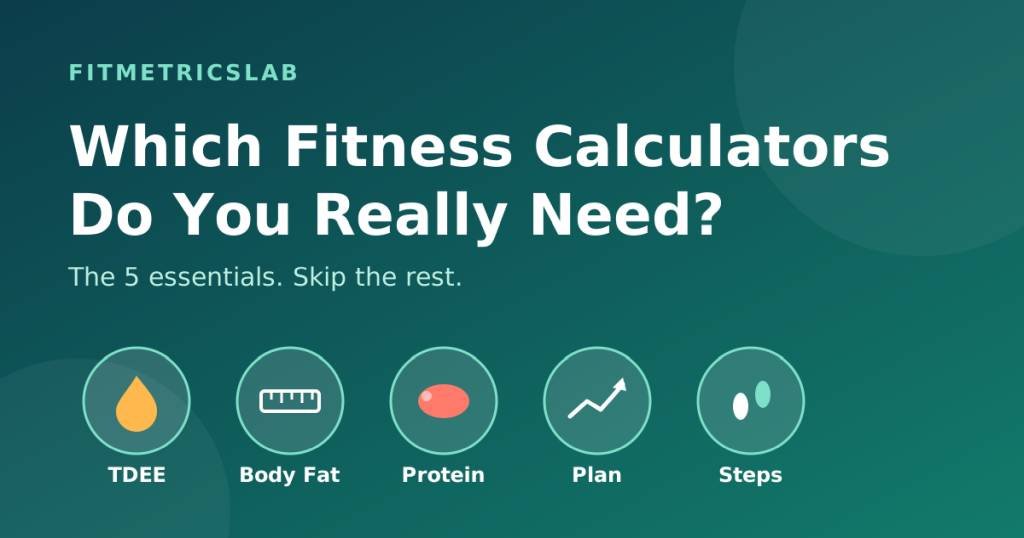
The truth is simple. For a normal, healthy life you need only a handful of calculators, and each answers one clear question. Here are the five that are genuinely enough.
1. TDEE Calculator: How Much Should You Eat?
Your Total Daily Energy Expenditure (TDEE) is the number of calories you burn in a day, including your resting metabolism (BMR) and all your movement. It is the foundation of every nutrition goal, whether you want to lose weight, maintain it, or build muscle.
Most good calculators use the Mifflin-St Jeor equation, which is widely recommended for healthy adults. Treat the result as an estimate, not a verdict. It is typically accurate to within about 10%, and two people with identical stats can burn quite different amounts of energy.
Practical tip: use the result as a starting point, eat around that level for two to three weeks, and watch your weight trend. If it stays stable, you have found your real maintenance calories.
Start with our TDEE calculator. Because BMR is already part of TDEE, you only need the separate BMR calculator if you are curious about your resting metabolism on its own. Not sure how the two differ? Read BMR versus TDEE for your daily calorie target.
2. Body Fat or Waist-to-Height Ratio: Are You Actually Healthy?
BMI is the most famous calculator, but also the most criticized. It cannot tell muscle from fat, so it can label a muscular person as overweight while missing excess fat in someone with low muscle mass.
Better options are easy to find:
- Waist-to-height ratio: divide your waist circumference by your height. A value under 0.5 is generally considered healthy, and the UK’s NHS describes 0.4 to 0.49 as typical. A 2017 study comparing five body measurements found it was the best predictor of both body fat percentage and visceral fat.
- Body fat calculator: methods based on simple tape measurements aren’t lab-accurate, but they are excellent for tracking progress over time. Try our body fat calculator.
Use BMI only as a quick reference, and let one of these two tell you the real story.
3. Protein Intake Calculator: Are You Eating Enough to Keep Your Muscle?
Protein is the one macronutrient worth calculating. The minimum recommended intake for sedentary adults is about 0.8 g per kilogram of body weight, but people who train, diet, or are getting older usually benefit from more. Commonly cited ranges for active people sit between roughly 1.2 and 2.0 g per kilogram.
Our daily protein intake calculator removes the guesswork and splits the total into meals, which makes it far easier to apply in real life. You don’t need a full macro calculator for fats and carbohydrates. If your calories and protein are right, the rest usually falls into place. If you do want to go deeper, see our macro tracking guide.
4. Weight Loss Plan Calculator: How Fast and How Long?
If weight loss is your goal, a plan calculator turns your TDEE into a realistic target. It tells you your daily calories, your expected weekly loss, and an approximate end date.
A moderate deficit of roughly 10 to 25% below maintenance is the sensible range for most people, usually resulting in about 0.5 to 1 kg per week. Crash diets look faster on paper, but they cost muscle, energy, and consistency.
A timeline also protects you from frustration. Seeing that your goal takes twelve weeks, not three, makes it far easier to stay patient. Build yours with the weight loss plan calculator, and if progress stalls along the way, read why weight loss plateaus happen and what to do.
5. Daily Steps and Water Intake: The Everyday Habit Trackers
These two are optional but useful, because they turn healthy living into simple daily targets.
- Daily steps: the old 10,000-step rule is a marketing number. Research suggests meaningful health benefits begin well below it, so a personalized goal based on your current activity is more motivating than an arbitrary figure. Find yours with the daily steps calculator, or follow our walking plan for beginners.
- Water intake: needs vary with body weight, climate, and activity. The daily water intake calculator gives you a sensible daily range, so you can stop wondering whether eight glasses is the answer.
What You Can Safely Skip
- Ideal body weight formulas as a strict target: they ignore muscle, frame, and age, so treat the optimal body weight calculator as a rough reference range, and let body fat or waist-to-height ratio guide your real progress.
- Calories burned calculators: these are rough guesses, and your TDEE already includes your activity level.
- Body age and fitness age tools: entertaining, but rarely actionable.
- One-rep max: useful only if you lift heavy and follow a structured program.
How to Use the Calculators Together
- Calculate your TDEE to find your maintenance calories.
- Check your waist-to-height ratio or body fat to see where you stand.
- Set a goal with the weight loss plan (or eat at maintenance or slightly above it to build muscle).
- Hit your protein target every day.
- Add steps and water as simple daily habits.
Recalculate every 4 to 6 weeks, or after a weight change of around 4 to 5 kg, because your numbers shift as your body does.
The Bottom Line
More calculators don’t mean better results. Five tools cover almost everything the average person needs: TDEE, body fat or waist-to-height ratio, protein, a weight plan, and daily habit targets. Remember that every calculator gives an estimate. Your real progress, measured by the mirror, your tape measure, and your weekly weight trend, is always the final judge.
Ready to start? Browse all our free fitness calculators and get your personalized numbers in under a minute.